
Dear Brands,
Be careful with seeding.
It’s not uncommon for a smart consumer to come across a seeded post for a certain brand, written in a painfully fake and “trying-too-hard” tone. And it makes me wonder: do brand managers actually control the quality of campaigns executed by seeding agencies?
I don’t think seeding is a bad tactic. On the contrary, seeded marketing has been studied as part of the marketing mix. What’s worth talking about is how this tactic has been distorted by many agencies in Vietnam into a twisted form of “astroturfing” marketing communication, even though it can be argued that it is still a tactic within firm-created WOM.
So, let’s clarify how firm-created WOM and astroturfing marketing are different, even though both ultimately serve the same goal: WOM Marketing.
WOM Marketing, at its ideal, is organic virality: something every communications team wants. From my observation, a viral WOM campaign is more likely to take off when the brand already has a strong enough position, or when the content itself is interesting enough for people to want to talk about and share.
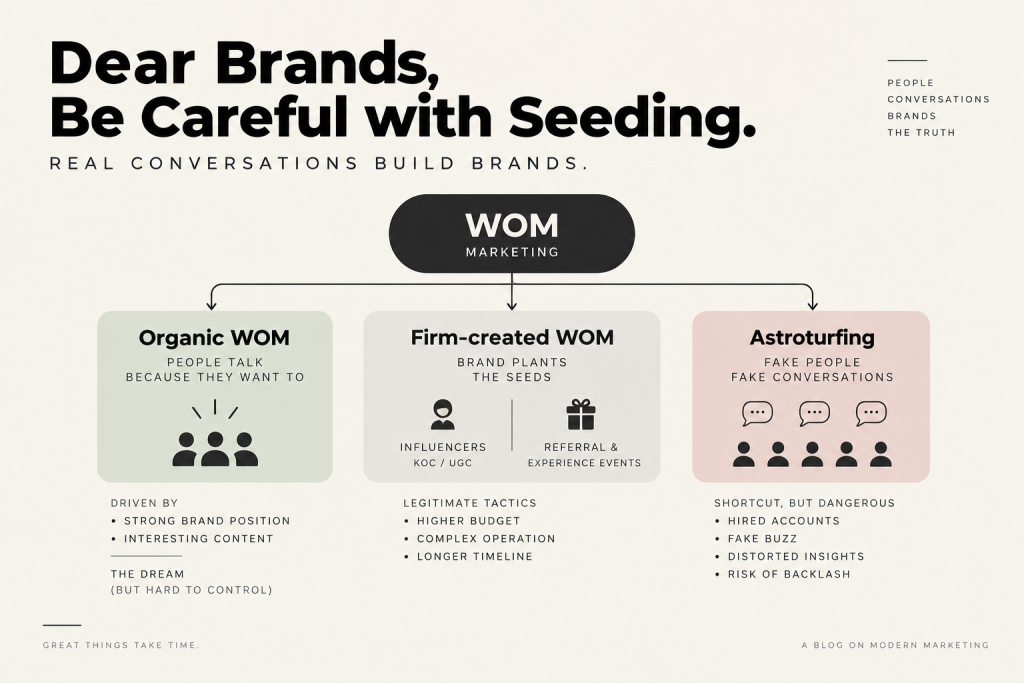
No agency would dare guarantee that a WOM campaign will go viral organically. So, if a brand wants to proactively create “Buzz” around a WOM campaign, it has to activate firm-created WOM marketing.
There are many ways for brands to proactively generate WOM, and here are two relatively transparent and common approaches you may already know:
- Product/service seeding through Influencers or KOC/UGC marketing.
- Referral & Experience Events (Online/Offline).
Both strategies are legitimate. However, they require significant budget, complex operations and execution, and often a relatively long implementation timeline. And that is exactly where a “shortcut” strategy comes in, which is fast, cheap, and arguably the most dangerous: Astroturfing, or fake seeding.
A post from an account that looks suspiciously like a clone of someone, talking about what a brand is doing, then triggering discussion through a bunch of other accounts that look equally “clone-ish”. This is a familiar tactic used by many seeding agencies today.
People are hired to say whatever they are told to say, without actually having to experience the product themselves.
I’m honestly surprised that we are already in 2026, yet some of these posting and commenting tactics still produce content that feels even more awkward than AI-generated content.
Social Listening can also become distorted at this point: a significant portion of the social buzz a brand sees may actually come from the very people hired to create the conversation.
Consumers today are highly sensitive to how brands communicate with them. If they feel deceived or manipulated, they may push back, create negative WOM, and turn a campaign designed to generate buzz into a backlash for the brand.
So, what should communications teams do to create WOM that is actually loud enough to increase brand presence or spread the creative ideas behind a campaign?
If your brand is rich, go ahead and use firm-created WOM for “spreading the seeds,” but do it transparently.
If you don’t have enough resources to implement either of the two firm-created WOM tactics above, focus on Customer Experience: Human-centric. Bring the best you can serve.
A good enough product and a genuinely thoughtful service will naturally turn your customers into your most loyal “seeders.”
It may take time. But so what?
Great things take time.
“The most powerful element in advertising is the truth.”
— Bill Bernbach